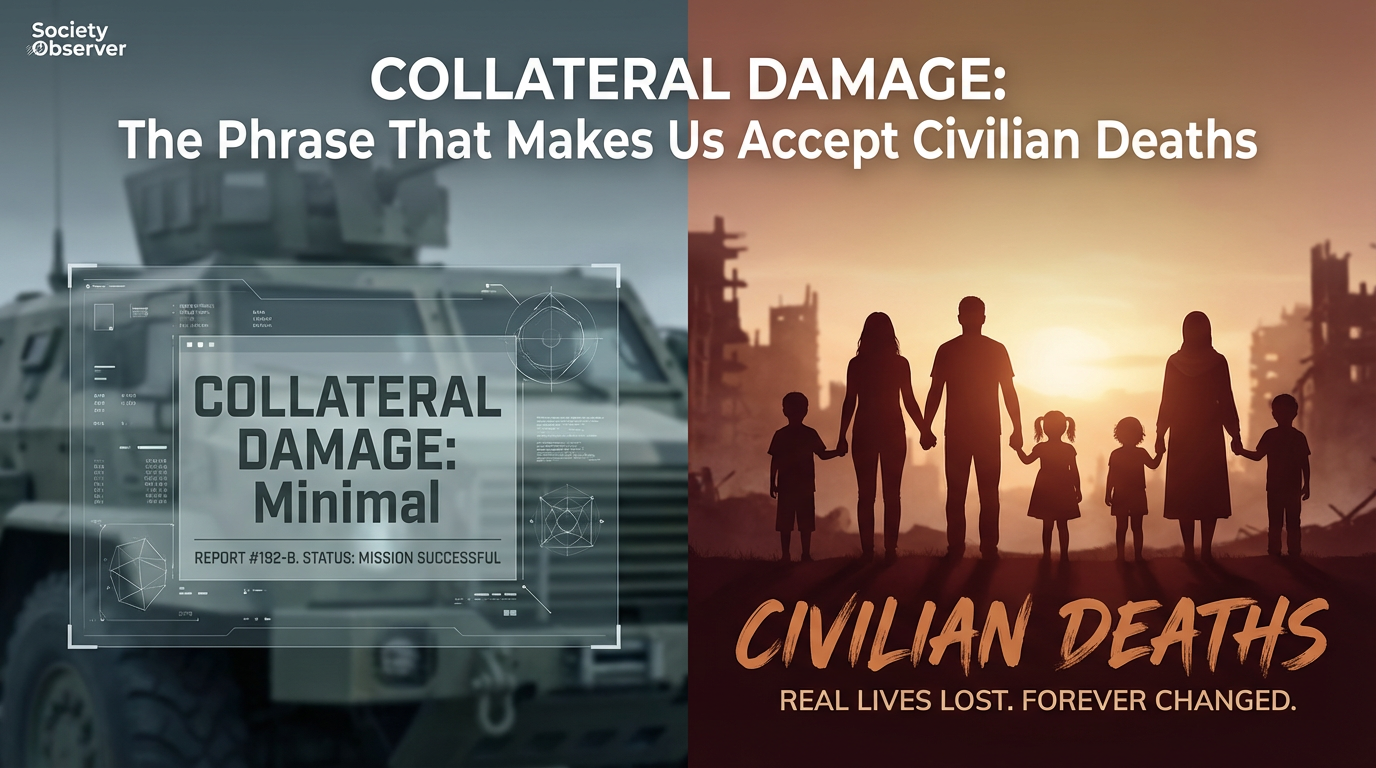
Collateral Damage: The Phrase That Makes Us Accept Civilian Deaths
Two words that changed how we talk about war deaths. When military operations kill civilians, the language we use shapes whether we feel outrage or acceptance. This analysis examines how five major outlets frame the same reality — and why it matters to you as a reader. Similar to our analysis of how media frames AI job displacement, the words chosen by journalists fundamentally alter public perception and policy response.
The Headlines: Five Different Lenses
None of these are "fake news." They're describing the same event. But the language creates completely different mental images.
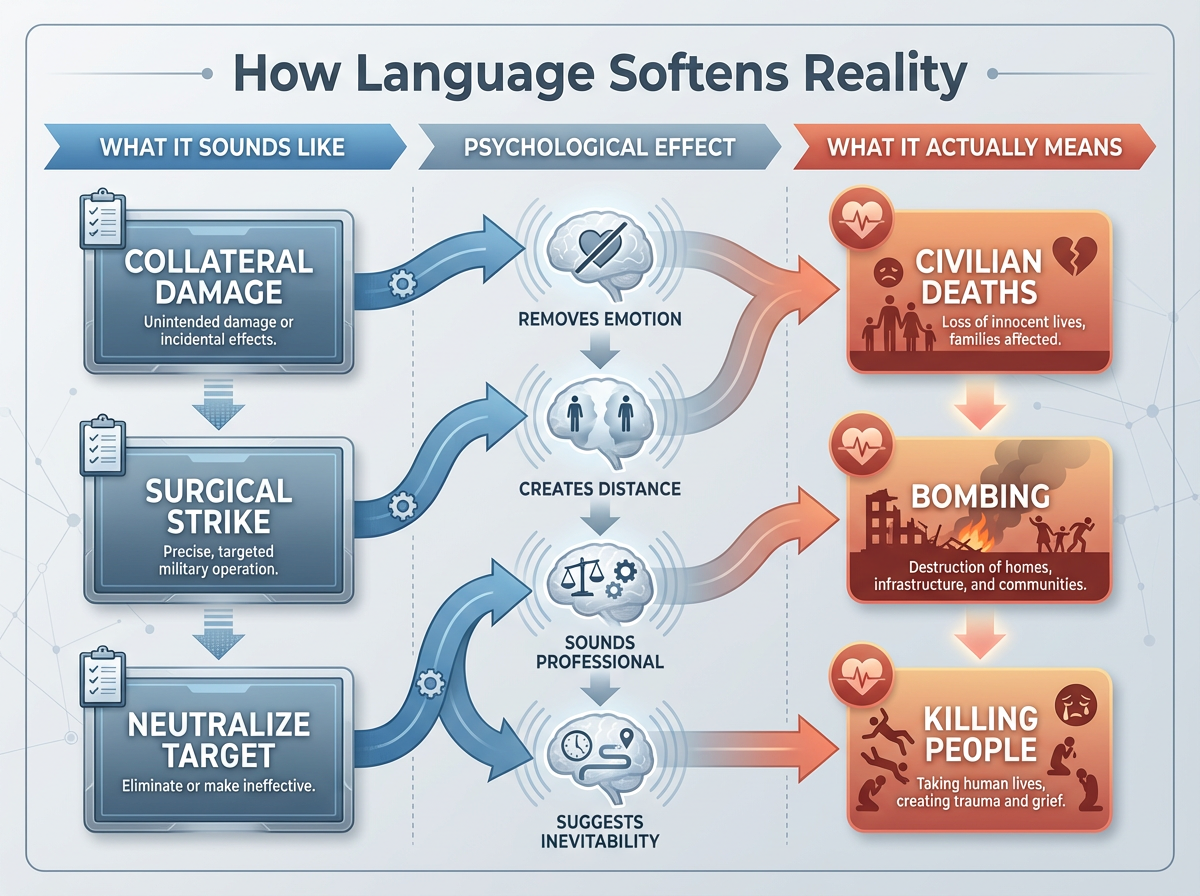
What the Language Is Really Doing
Emotional Tone
Clinical, technical, distantLanguage designed to minimize emotional response. The phrase "collateral damage" was coined during the Vietnam War specifically to make civilian deaths sound like a side effect rather than a tragedy.
Sentence Structure
Three layers of softening:
- "Regrettable" — implies an apology without accepting responsibility
- "Collateral" — means "secondary" or "unintended"
- "Precision Strike" — emphasizes technological accuracy, creating cognitive dissonance with the outcome
What It Hides
Who died. How they died. Whether they were children. Whether this happens often. Whether any protocol was violated.
Psychological Effect
Readers process this as a technical problem — like a manufacturing defect — rather than human lives lost.
Emotional Tone
Neutral, factual, attributed. This is standard wire-service language: state the facts, attribute the source, move on.
Sentence Structure
- Active verb: "Kills" — direct causation
- Number: "15 Civilians" — specific, not vague
- Attribution: "Military Says" — signals the source, allowing readers to assess credibility
What It Shows
Reuters uses plain language but still adopts the military's framing by leading with "Air Strike" (tactical language) rather than "Bombing" (more emotional).
Emotional Tone
Concerned, pattern-focused, accumulative. The word "mount"Suggests growing concern and ongoing crisis implies an escalating crisis.
Sentence Structure
Two-part construction:
- "Deaths Mount" — emphasizes pattern and trend
- "Bombing Campaign Continues" — suggests deliberate, sustained action
Psychological Effect
Frames this as part of a larger story, not an isolated incident. Invites readers to see systematic impact.
Emotional Tone
Mission-focused, minimizing. The headline centers the objective (targeting enemy positions) not the outcome (civilian deaths).
Sentence Structure
- "Target Enemy Positions" — emphasizes intent, not result
- Semicolon construction — the second clause feels like an afterthought
- "Some Casualties" — vague, passive, no distinction between military and civilian
What It Hides
That all or most casualties were civilians. The specific number. The context of the operation.
Emotional Tone
Urgent, humanizing, specific. The phrase "including children"Invokes protective instinct and moral concern is designed to provoke moral response.
Sentence Structure
- "Fifteen Dead" — leads with human cost
- "Including Children" — specific vulnerable group
- "Latest Airstrike" — suggests ongoing pattern
Psychological Effect
Creates immediate emotional connection. Hard to read as "unfortunate but necessary."
How They Differ: Side-by-Side
Emotional Intensity Scale
| Source | Emotional Tone | Focus | What's Emphasized |
|---|---|---|---|
| Pentagon | Technical, apologetic | Procedure & accuracy | "Precision" technology |
| Reuters | Neutral | Facts & attribution | Number killed |
| The Guardian | Concerned | Pattern & accumulation | Ongoing trend |
| Fox News | Mission-supportive | Military objective | Enemy targets |
| Al Jazeera | Urgent | Human cost | Victims (especially children) |
None of these outlets lied. But the framing creates vastly different reader experiences.
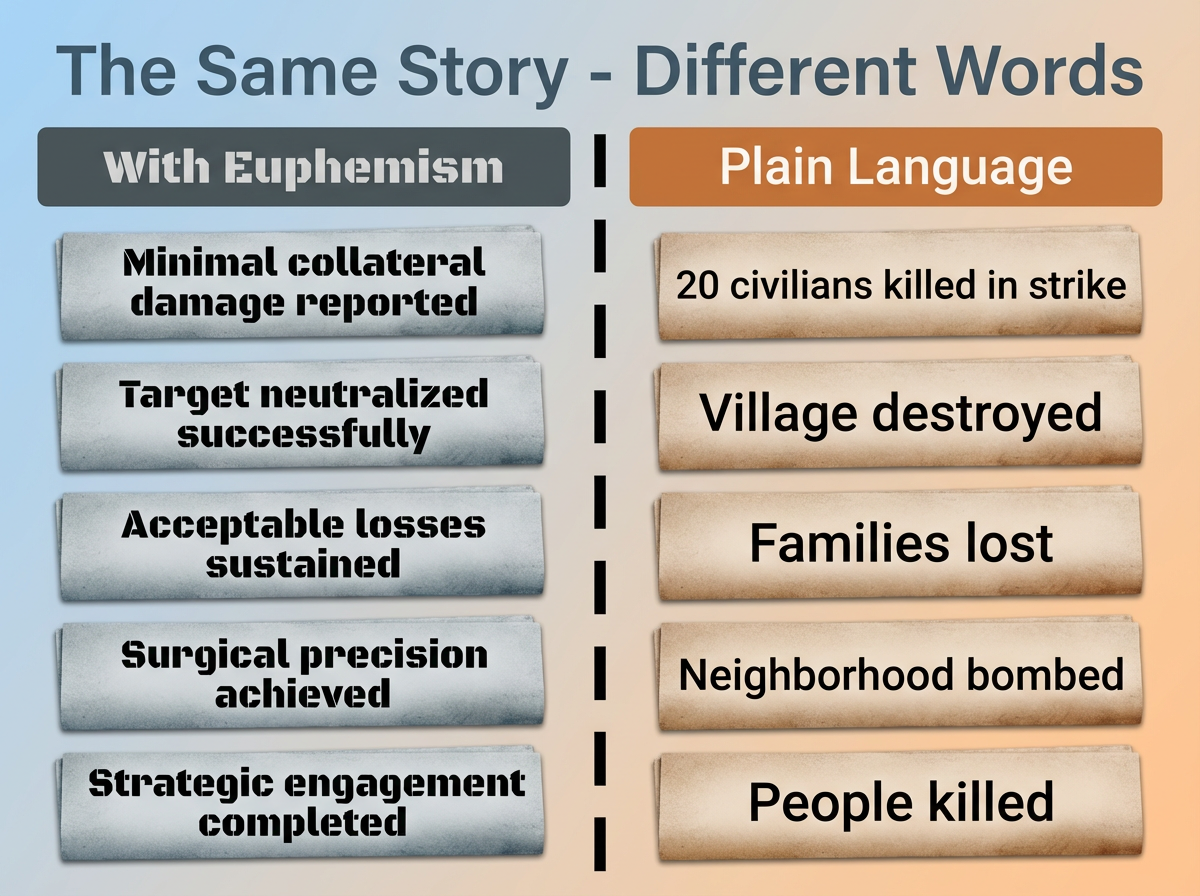
What's Often Missing From Headlines
How to Read Coverage of Civilian Casualties
Your 5-Question Framework
"Killed" vs. "collateral damage"Active verbs create responsibility; passive nouns hide it — one assigns agency, the other hides it.
"Several casualties" vs. "15 civilians killed" — specificity matters.
Military sources only? Independent witnesses? Medical staff?
Watch for: neutralized, eliminated, collateral, surgical, precision.
Technology/tactics vs. human cost? Mission success vs. impact on civilians?
Example in practice:
"Precision airstrikes successfully neutralized multiple targets; some collateral effects reported."
Translation: "We bombed several locations. Some civilians died."
Why the Language Matters to You
You might be thinking: "This is just semantics. The people are still dead."
Exactly. And that's the point.
The language doesn't change what happened. It changes:
- How we feel about it — outrage vs. acceptance
- What we do about it — demand accountability vs. move on
- How future policy is shaped — stricter rules of engagement vs. business as usual
- Which stories we remember — and which we forget by tomorrow
When the Gaza conflict and the war in Ukraine produce vastly different casualty coverage despite similar civilian death tolls, language is doing work. It's deciding who counts as a "real" victim and whose death is just… unfortunate.
How does this article make you feel?
Your reaction is stored locally — no tracking.
The Calm Takeaway
Language is never neutral. When you see "collateral damage," someone chose that phrase. When you read "precision strike killed civilians," someone chose that phrase.
Neither is more "true." But one makes you think about technology. The other makes you think about people.
At Society Observer, we believe the best defense against manipulation isn't anger — it's awarenessRecognizing patterns without losing your calm. Read all five headlines. Notice the differences. Ask yourself: What am I being invited to feel?

Urooj Mukhtar is a senior writer and analyst at SocietyObserver, where she examines power, conflict, and media narratives through deeply researched, evidence-based reporting. Her work focuses on the human consequences of political decisions, the language of war and policy, and how narratives shape public consent. Beyond her investigations, she enjoys good food and a well-made cup of coffee.