How 5 Major Outlets Framed AI Job Displacement — And Why the Language Matters
Artificial intelligence and its impact on jobs is being discussed across the world.
The story has been covered by outlets from the BBC to Fox News to CNN — but even when the underlying facts are similar, the way they are framed can change how we understand them and how we feel about the future.
In this article, we look at 5 headlines and story approaches from major news outlets, all reporting on AI's impact on employment — and notice how language, tone, and emphasis create different meanings.
This is not about judging any outlet.
It's about understanding how framing works — so we can read more thoughtfully.
The Headlines
Here are 5 real examples of how different outlets reported on AI's impact on jobs between December 2025 and January 2026. Each headline is quoted exactly as written on the site at the time of publication.
BBC (December 18, 2025) — "AI likely to displace jobs, says Bank of England governor"
Source
Reuters (December 4, 2025) — "AI's rise stirs excitement, sparks job worries"
Source
New York Times Opinion (December 27, 2025) — "A 1 Percent Solution to the Looming A.I. Job Apocalypse"
Source
Fox 13 News (December 30, 2025) — "AI's next disruption: Analysts say 2026 could bring widespread job shifts"
Source
CNN (December 18, 2025) — "The surprising truth about AI's impact on jobs"
Source
(Notice how different they sound — even though they all describe AI's relationship to employment.)
Close your eyes and recall: Which headline made you feel most worried? Most curious? Most reassured? Your gut reaction reveals how powerful framing is — even before you read a single word of the article.
What the Language Is Really Doing
Let's slow down and look at what each headline emphasises.
"AI likely to displace jobs, says Bank of England governor"
This headline is:
✔ calm
✔ authoritative
✔ predictive
The key framing choice here is who is speaking: the Bank of England governor, Andrew Bailey. This isn't a tech CEO, a union leader, or a journalist speculating. It's the head of Britain's central bank — an institution responsible for economic stability.
The word "displace"Move from usual position - softer than "eliminate" is also carefully chosen. It's softer than "eliminate" or "destroy," but more concrete than "affect" or "change." The headline suggests inevitable movement — jobs will shift — but doesn't specify whether this is catastrophic or manageable.
The tone created: authoritative concern. This isn't alarmism, but it's not dismissal either. It positions the story as a serious economic issue that institutions are monitoring.
What this framing does: It legitimises concern about AI job displacement without inducing panic. The reader is nudged to think: "If the Bank of England governor is saying this, I should pay attention — but calmly."
"AI's rise stirs excitement, sparks job worries"
Notice the structure: two contrasting emotions in one headline.
✔ "Stirs excitement" (positive)
✔ "Sparks job worries" (negative)
This is classic wire-service neutrality — presenting both sides without choosing. The headline tells you: some people are excited, some people are worried. Both reactions exist simultaneously.
The verbs matter too:
- "Stirs" and "sparks" are both gentle, almost poetic. Neither word suggests an explosion or crisis. They suggest movement, energy, something beginning.
The tone created: balanced ambiguityUncertainty or having multiple interpretations. AI is not painted as purely good or purely bad. The story exists in the space between hope and fear.
What this framing does: It allows readers from different perspectives to engage with the story. Those optimistic about AI can focus on "excitement." Those worried can focus on "job worries." The headline offends no one — but also doesn't guide readers toward any particular conclusion.
"A 1 Percent Solution to the Looming A.I. Job Apocalypse"
This is the most emotionally charged headline in our set — and importantly, it's labelled "Opinion."
Key word: "Apocalypse"
This is biblical language. It suggests total destruction, the end of something fundamental. Even though the article proposes a solution (the "1 percent" reference to corporate profit-sharing for retraining), the headline leads with catastrophe.
The word "looming"Appearing as a shadowy form, especially in a threatening way adds temporal urgency: this isn't happening far in the future. It's approaching. It's almost here.
The tone created: urgent alarm combined with actionable solution. The writer (Sal Khan, CEO of Khan Academy) wants readers to feel the scale of the threat — but also to believe something can be done about it.
What this framing does: It justifies immediate action. If this is an "apocalypse," then small, incremental responses won't work. The language demands significant intervention. It also signals the writer's perspective: this is advocacy journalism, not neutral reporting.
Interestingly, the actual article content is more measured than the headline suggests. Khan writes: "I believe artificial intelligence will displace workers at a scale many people don't yet realize." But "displace workers at a scale" became "Job Apocalypse" in the headline — a significant emotional escalation.
"AI's next disruption: Analysts say 2026 could bring widespread job shifts"
This headline does three things simultaneously:
- Assumes disruption: AI's "next" disruption — not its first, not a potential disruption, but the next one in a series.
- Cites analysts: This gives the claim authority without naming specific sources in the headline. "Analysts say" is softer than "economists warn" but stronger than "some people think."
- Uses the word "shifts": Not "losses," not "destruction," not "elimination" — but "shifts". This is softer language that suggests movement rather than disappearance.
The time specificity matters: "2026 could bring" — this is happening soon, within months. The story is immediate and local (Fox 13 is Tampa-based), making it relevant to viewers wondering about their own jobs.
The tone created: informed warning without catastrophism. It says: credible people think this is coming soon, and it will be significant. But "shifts" leaves room for adaptation.
What this framing does: It positions AI job impact as a 2026 story, creating news urgency. Readers who ignored AI coverage in 2024-2025 might think, "This time it's really happening." The focus on "widespread" suggests scale without specifying whether this is good, bad, or neutral.
"The surprising truth about AI's impact on jobs"
This headline is fascinating because it's structured as a counter-narrative.
The word "surprising"Causing surprise; unexpected signals: What you've heard is wrong. We have new information that contradicts the dominant story.
The phrase "truth about" suggests revelation — we're going to tell you what's really happening, not what everyone else is saying.
The article itself reports Vanguard research finding that jobs highly exposed to AI are actually growing faster than before COVID-19, not shrinking. This directly contradicts the other four headlines in our set.
The tone created: corrective optimism. CNN is positioning itself as the outlet that digs deeper and finds the data everyone else missed. It's saying: "Don't panic. The scary story isn't supported by evidence — yet."
What this framing does: It appeals to readers exhausted by doom narratives. It offers relief: maybe AI isn't the job-killer everyone says it is. But the phrase "at least for now" (which appears in the article) leaves the door open — this might change.
This is also trust-building journalism: "We're not just repeating what everyone else says. We checked the data."
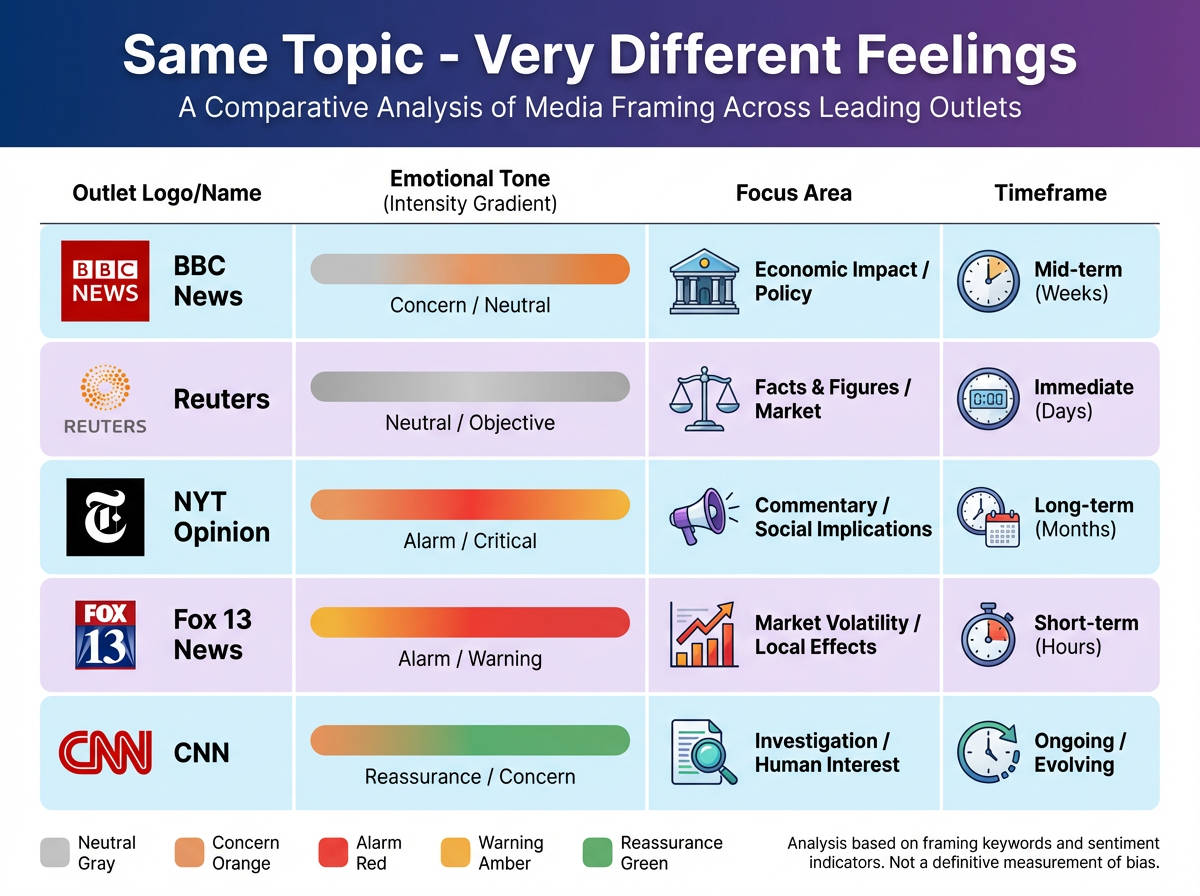
So… Same Topic. Very Different Feelings.
Look at the emotional spectrum:
| Outlet | Emotional Tone | Focus | Timeframe |
|---|---|---|---|
| BBC | Authoritative concern | Institutional warning (Bank of England) | Inevitable, gradual |
| Reuters | Balanced neutrality | Dual perspectives (excitement vs worry) | Present moment |
| NYT Opinion | Urgent alarm | Call for corporate action | "Looming" (imminent) |
| Fox 13 | Informed warning | Analyst predictions, local impact | 2026 (specific, soon) |
| CNN | Contrarian reassurance | Data contradicting fear narratives | Current reality |
None of these are "fake."
None are fundamentally misleading.
But they guide attention differently.
And where attention goes → meaning forms.
Why Does Framing Matter?
Because words shape emotional response — and emotional response shapes behavior.
"Apocalypse" → I should be afraid → I might demand drastic policy intervention → or I might feel paralyzed
"Displacement" → This is a serious transition issue → I should think about retraining → or support government planning
"Shifts" → Change is happening but manageable → I should adapt → or stay alert but not panic
"Surprising truth" → Maybe I was worried for nothing → I can relax → or I should be skeptical of alarmist coverage
The story about AI and jobs is real. The technology is advancing. People's livelihoods are at stake.
But how we talk about it determines whether we respond with:
- Thoughtful planning
- Panic
- Denial
- Acceptance
- Mobilization
- Paralysis
That's why language matters.
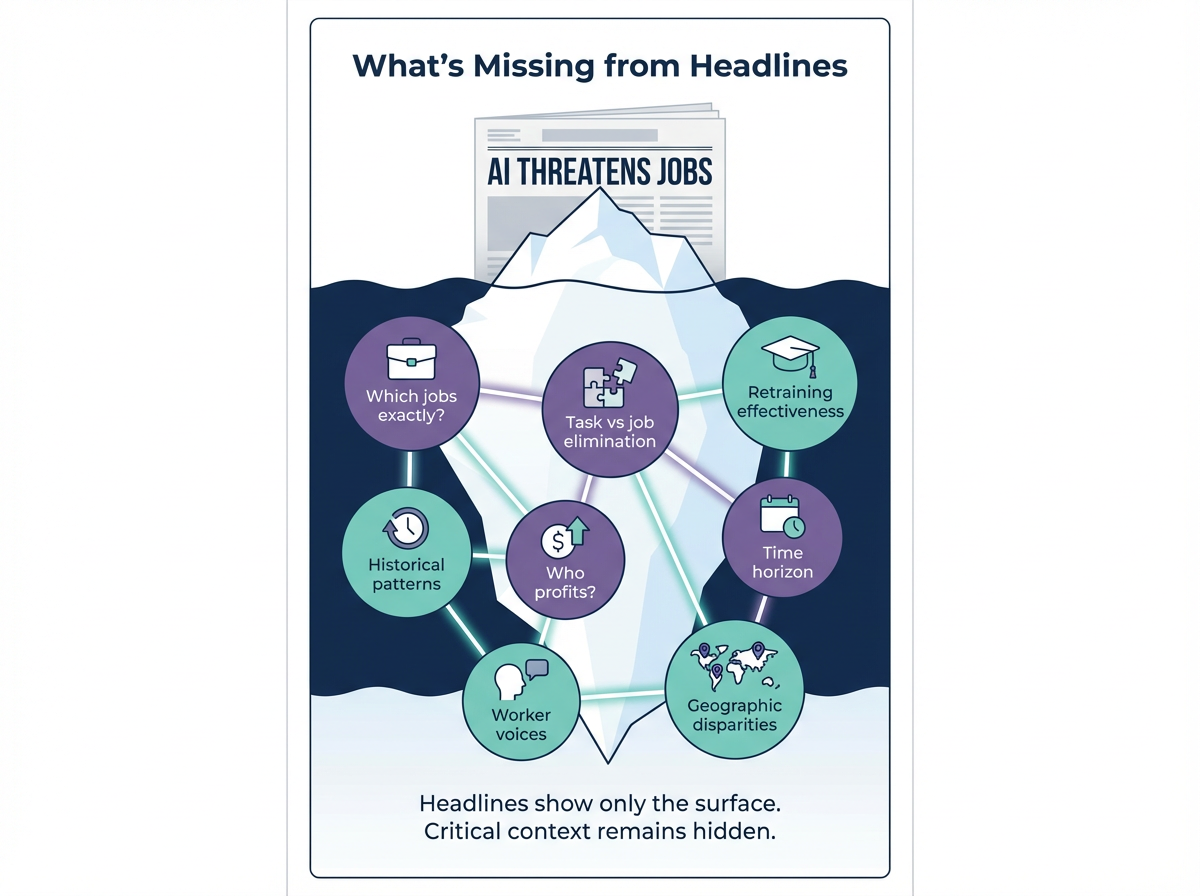
What's Often Missing From Headlines
Headlines rarely include:
Because a headline must be short.
Your job as a reader is to look beyond it.
A Calm Way to Read Headlines About AI and Jobs
Here's a simple method you can use.
Ask yourself:
-
1️⃣ What emotion does this headline create?
Fear? Excitement? Confusion? Curiosity? Reassurance? Notice your gut reaction before you read the article. -
2️⃣ Where is attention directed?
Is the focus on workers who might lose jobs? On companies adopting AI? On economists' predictions? On what hasn't happened yet (reassurance)? Different focuses serve different purposes. -
3️⃣ What story is not being told?
Who profits if AI displaces workers? What are displaced workers actually doing? What does "job displacement" mean in practice — unemployment, lower wages, career changes? Are there industries hiring because of AI? -
4️⃣ What words are emotionally loaded?
Like: "Apocalypse" (suggests total destruction), "Disruption" (sounds inevitable, tech-positive), "Displacement" (sounds institutional, neutral), "Threatens" (suggests danger), "Transforms" (sounds positive, evolutionary), "Surprising truth" (suggests others are wrong) -
5️⃣ What's the timeframe?
"AI could replace jobs someday" → vague future. "2026 will bring job losses" → specific, soon. "No evidence of widespread impact yet" → current reassurance. Urgency framing changes everything.
This Is Not About Blaming Media
Different outlets serve different audiences.
The BBC is a public broadcaster with a mandate for institutional credibility.
Reuters is a wire service selling to other newsrooms — neutrality is its brand.
The New York Times Opinion section exists to advocate for policy solutions.
Local news like Fox 13 focuses on immediate, regional relevance.
CNN positions itself as going deeper than surface-level narratives.
None of these roles are wrong.
But being aware of framing gives you power as a reader.
Power to pause.
Power to think.
Power to ask: Why is this story being told this way, right now?
And in a time of rapid technological change, calm thinking is a form of quiet resistance to manipulation — by any side, for any purpose.
Final Thought
AI and jobs — this topic will be with us for years.
It will become political.
It will become technical.
It will become emotional.
It will become personal.
Some headlines will try to scare you.
Some will try to reassure you.
Some will try to mobilize you.
Some will try to confuse you.
But the facts are only half the story.
The language that delivers those facts — the choice between "apocalypse" and "shift," between "disruption" and "displacement," between "surprising truth" and "looming threat" — that's what shapes how we understand the future of work.
And that is the journey we are exploring here at Society Observer. 🌍

Urooj Mukhtar is a senior writer and analyst at SocietyObserver, where she examines power, conflict, and media narratives through deeply researched, evidence-based reporting. Her work focuses on the human consequences of political decisions, the language of war and policy, and how narratives shape public consent. Beyond her investigations, she enjoys good food and a well-made cup of coffee.